‏إظهار الرسائل ذات التسميات USA vs Europe. إظهار كافة الرسائل

الأربعاء، 12 فبراير 2014

Italy, US crack down on mafia drug smuggling

U.S. and Italian authorities said Tuesday they had broken up a new heroin-and cocaine-trafficking ring coordinated by Italy's powerful 'ndrangheta organized crime syndicate and New York City's Gambino crime family. Seventeen people were arrested in Italy and another seven in New York, officials said.
The investigation underscored how `ndrangheta is spreading its operations beyond Italy's borders as it consolidates its position as one of the world's most powerful drug traffickers, officials said. It also laid bare how the `ndrangheta, based in the southern region of Calabria, is encroaching on territory once occupied by the Sicilian-based Cosa Nostra, since the Gambinos were the Sicilian Mafia's U.S. branch.
Italian anti-Mafia police said the "New Bridge" operation targeted a new cocaine trafficking route from South America to the southern Italian port of Gioia Tauro that united the Gambinos with the `ndrangheta. In exchange, the Italians were to provide heroin to the American market.
The aim was to "build a bridge of criminality and corruption to stretch from South America to Italy and back to New York," said Marshall Miller, a top prosecutor in the U.S. Attorney's office in Brooklyn.
Using wiretaps and an undercover agent named "Jimmy" who infiltrated the Brooklyn-based mob, officials said they thwarted the delivery to Italy of some 500 kilograms of pure cocaine that was to have been hidden in shipments of canned coconuts and pineapples being shipped from Guyana to Gioia Tauro.
"The `ndrangheta can and has to be considered one of the most powerful organizations in the world for handling of international drug-trafficking," said Raffaele Grassi, head of the Italian police's central operative service unit. "The `ndrangheta has left its territory of origin: beyond occupying areas of our country and infiltrating itself in northern Italy, the `ndrangheta is looking for criminals beyond the borders, invading new markets to make profit."
FBI agents worked alongside Italian police in Italy and vice versa, and Miller and other officials from the U.S. Attorney's office in Brooklyn were on hand in Rome for the press conference announcing the arrests. The Italian suspects are accused of mafia association and drug trafficking, among other charges. Miller said one of the U.S.-based suspects was accused of laundering money through a Brooklyn-based bank and that several hundred thousand dollars was seized.


Associated Press

الثلاثاء، 11 فبراير 2014

The Sex Benefits Of Yoga For Men


When it comes to yoga, many men don’t think of this ancient art to help them in the bedroom.  But because of the various moves and styles, yoga can help the longevity and increase the intensity of orgasms.  Below are some of the “mood-boosting” moves.
Plank
Do it: Lie facedown on the floor as if you were about to do a push-up. Stay on the balls of your feet, inhale deeply, and then exhale as you push up until your arms are straight. Try to lengthen your body as much as possible while keeping it as straight as a plank. Hold for 30 seconds.
Sex benefits: Lengthens the spine and strengthens your shoulders and lower-back muscles, while toning your abs and sexual core (pelvis and perineum).
Downward Dog
How To Do it: Start out like you would for the plank, except this time balance on the tops of your feet. Straighten your arms, arch your back, and push your torso up. The only thing touching your mat should be the palms of your hands and the tops of your feet. Hold for 30 seconds.
Sex benefits: Increases blood flow to your sexual core, improves lower-back flexibility, and develops wrist, arm, and abdominal strength.
Upavistha Konasana (Wide-Legged Straddle Pose)
How to do it: Sit on the floor with your legs wide. Leg muscles are activated and toes and kneecaps point straight up. Lean your torso forward as far as it goes comfortably. Hold for 5 to 10 deep breaths.
Sex Benefits: Increases blood flow (and thus sensation) in the pelvis.

Baddha Konasana (Bound Angle Pose, also known as Cobbler’s Pose)
How to do it: Sit with your knees bent and soles of the feet touching. Lightly hold your big toes and lean your torso forward over your legs (back is gently rounded). Hold for 5 to 10 deep breaths.
Sex benefits: Alleviates urinary and uterine disorders. Strengthens the uterus. Eases irritability, anxiety and fatigue, three reasons we might choose not to have sex.


By Gerald Payne

EU Terrorizes Switzerland Over Vote to Limit Immigration

The European Union is terrorizing voters in Switzerland and threatening retaliation against the tiny nation, which is not in the EU, after the Swiss voted on February 9 to limit immigration in a national referendum. Amid outrageous verbal attacks on the Swiss themselves — senior EU officials have been suggesting that “xenophobia” was behind the vote — out-of-touch European politicians and bureaucrats are even warning that Switzerland could lose its current bilateral access to the “common market” ruled by the emerging super-state in Brussels.

The EU, famous for ignoring the public to impose its will, has already started adopting the “consequences” promised by its apparatchiks. According to news reports, the unaccountable regime just suspended talks with Switzerland on incorporating Swiss utilities into the broader European energy market. “No technical negotiations on the electricity agreement are foreseen between Switzerland and the EU at the moment in light of the new situation,” European Commission spokeswoman Pia Ahrenkilde-Hansen announced to reporters in Brussels on February 11. More pain has been promised. 

With the neutral Alpine nation facing a tsunami of immigrants from Europe who do not share their generally liberty-minded values and culture, concerns over unrestricted immigration under bilateral treaties finally came to a boil this year. Already, some 25 percent of the population is foreign born — about two thirds of that total come from EU nations — and many native Swiss people have long felt that the nation was losing its culture. With Switzerland’s freer economy leaving the EU in the dust in terms of growth, wages, wealth, innovation, and employment, the influx of foreigners showed no signs of easing. 


In response to the situation, the center-right Swiss People’s Party (SVP), the nation’s largest, organized the referendum to seek public input on the issue — a common occurrence in Switzerland, where the people get the final say if they want it. Voters narrowly decided that curbs on immigration were needed, with 50.3 percent voting to scrap a 2002 deal with the EU allowing “free movement” of people across the borders. A majority of cantons also backed the proposal. The Swiss federal government, which opposed the limits before the vote, will reluctantly begin implementing a quota system sometime this year in accordance with the referendum result.      

Foreign ministers from formerly sovereign nations across Europe, whose governments continue to impose more “integration” and unaccountable governance on the peoples of the bloc without their consent, lambasted the Swiss decision. Multiple officials even claimed infinite immigration was somehow a “sacred principle” for Europe. Ironically, however, all across the controversial bloc, liberty-minded parties seeking to put the brakes on unlimited mass immigration are soaring in the polls. From France and the United Kingdom to the Netherlands and beyond, European voters are becoming increasingly weary of what critics say is a power-hungry regime with totalitarian tendencies in Brussels.

In response to the growing outrage over the EU and unrestricted immigration, top EU commissars have increasingly resorted to Saul Alinsky-style tactics to attack their opponents. Among other strategies, extremist European “integration” zealots, who now openly declare their intention to build a “United States of Europe” after decades denying it, have resorted to demonizing the public they supposedly work for. Former EU commissioner and attorney general Peter Sutherland, for instance, claimed opponents and even skeptics of smashing national sovereignty were somehow extremists and racists.

After the latest Swiss vote, in between open threats, top European politicians made similar suggestions, sounding like petulant children. “Switzerland has rather damaged itself with this result,” claimed German Foreign Minister Frank-Walter Steinmeier after arriving in Brussels, even as demands grow for a similar referendum in Germany. “Switzerland must realize that cherry-picking with the EU is not a long-term strategy.” In other words, voters — even those who have consistently rejected the EU — must have no say about the march toward total EU domination of Europe.

Other foreign ministers made similarly outrageous remarks threatening tiny Switzerland — among the freest and most prosperous societies in the world and consistently ranked number one on just about every metric. “There will be consequences, that's clear,” warned Luxembourg Foreign Minister Jean Asselborn, coming off more like a schoolyard bully than a respectable public servant. “You can't have privileged access to the European internal market and on the other hand, dilute free circulation.”

Irish Foreign Minister Eamon Gilmore, meanwhile, took the hysteria a step further, calling the result of the Swiss people’s vote “very disturbing.” Of course, the obligatory smears of millions of Swiss citizens and EU subjects could not be avoided, either. “I think we have seen throughout Europe a growth in what I can only call an extreme-right agenda which is quite xenophobic,” Gilmore told reporters, using a typical tactic employed by totalitarians throughout history.   

Foreign Minister Laurent Fabius with the Socialist French government said the decision by Swiss voters was a “worrying” development, which he claimed showed that Switzerland — famous for international trade — was somehow “withdrawing” into itself. “We’re going to review our relations with Switzerland,” Fabius said during a radio program. Top EU bosses made similar remarks vowing to retaliate against the Swiss for standing up to their demands and wild fear mongering. The bloc surrounds Switzerland on all sides.

Swiss officials, meanwhile, while acknowledging that they are bound by the public’s decision, tried to downplay the hysterical talk coming out of politicians and bureaucrats in Brussels and European capitals. Big business interests — business-friendly Switzerland hosts international or regional headquarters for numerous major global corporations fleeing bloated welfare regimes — lamented the decision, saying it would be harder for companies to recruit the talent needed to grow. The public, however, concerned about what critics of unrestricted immigration say is the ongoing destruction of Swiss culture, were willing to take the risks.

While the establishment and its mouthpieces slammed the decision, liberty-minded analysts celebrated it. “There is surely no doubt that Switzerland, as one of two remaining important Western republics, continues to offer a challenge to those who seek aggressive globalism,” noted the free market-oriented Daily Bell. “Switzerland's carefully preserved culture and free-market virtues are ever a challenge to those who want to break down the borders of nation-states in order to create an evolving, expansive internationalism. But now — finally — Switzerland has pushed back.”

As The New American reported in 2011, EU bullying of tiny Switzerland and its voters has been a persistent and ongoing problem. Despite not being a member of the sovereignty-crushing regime, bloated high-tax EU member governments and Brussels itself were demanding Swiss voters raise taxes as companies and capital fled the bloc to lower-taxed, liberty-oriented cantons across Switzerland. Since then, the outrageous threats and coercion have only accelerated, with the EU treating Swiss voters as subjects required to comply with Brussels’ decrees. The super-state’s “war” on Switzerland continues.

Of course, the Obama administration has been terrorizing Swiss voters for years as well. Using a combination of threats and intimidation, the U.S. government ultimately succeeded in forcing Switzerland to obey its decrees on banking secrecy, data sharing, and more. Numerous tax-funded international outfits such as the OECD have also been scheming to crush Swiss freedom and sovereignty under the guise of helping revenue-hungry politicians around the world extract more tribute from citizens. 

While what little public support existed for the EU continues to evaporate across the region, political parties seeking to exit the controversial union and restore national sovereignty are dominating at the polls across much of the bloc. However, so-called “eurocrats” and the establishment behind the radical project are unlikely to abandon their decades-old dream of a Europe ruled by an unaccountable and unelected behemoth — at least not any time soon. Swiss voters, though, would be wise to continue standing up against the flailing bully as it implodes from within.


Written by  Alex Newman

Sochi Olympics: Propaganda and Theft Amid PR “Disaster” for Putin

Before the $51 billion games began, the increasingly discredited establishment media tried desperately to make the Sochi Olympics about homosexuals and a Russian law banning sexual propaganda to minors. The real stories, though, were largely overlooked — at least until Olympians began arriving with cameras and Twitter accounts. Now, as fears grow, the games are being variously portrayed as a joke, a propaganda stunt, a bonanza of corruption, and a serious danger — and in some cases, a testament to the supposed glory of former KGB man Vladimir Putin and the Russia he rules.  

Almost incredibly, some elements of the misleadingly labeled “mainstream” U.S. press were busy glorifying Russia and its Soviet past, prompting outrage and ridicule among analysts. “Russia transcends. Through every stage of its story, it's resisted any notion of limitation,” swooned Peter Dinklage on NBC during the Olympics’ opening ceremony, omitting any mention of communist gulags or mass murder. The blood-drenched revolution that led to the creation of one of the most barbaric slave states, Dinklage continued, “birthed one of modern history's pivotal experiments.”  

Separately, NBC’s Bob Costas is being ridiculed for portraying Putin as some sort of exalted “peace” maker. “Just in the past year, Putin brokered a deal to allow Syria to avoid a U.S. military strike by giving up its chemical weapons,” he said as pictures of Putin appeared on the screen. “And helped bring Iran to the negotiating table over its nuclear intentions.” Critics said NBC was sounding more and more like a Russian propaganda network or a “Putin cheerleader,” with analysts pointing out that it is hardly the first time NBC has deceived viewers by painting a rosy picture of Russia’s barbaric Soviet era.  


Outside of NBC programming, though — where the biggest pseudo-controversy appears to be a law banning sexual propaganda to children — reality was slowly setting in. Surrounded by pictures of “President” Putin — similar to familiar sights across Third World dictatorships — journalists and athletes from around the world have been providing non-stop photographic evidence that the 2014 Olympics are a “disaster.” BBC Moscow bureau chief Kevin Bishop, for example, sent out a tweet saying that while his hotel did not yet have the floor finished, it did have a picture of Putin (apparently not suitable for sleeping).  

The problems are so bad — many have been tweeted with the popular hash tag #SochiProblems — that the Winter Games are already being dubbed the “most corrupt” Olympics ever. The plumbing and the toilets do not work. The hotels and infrastructure are crumbling. There are not enough pillows. Corruption is running rampant, along with stray dogs and cats. Yoghurt for U.S. athletes is stuck in limbo. Major security concerns, including “instantly hacked” laptops and the threat of terrorism, refuse to subside.

According to news reports, by the time visitors to Sochi connect their laptops or phones to Russian networks, it is probably too late to protect the data. “Visitors to Russia can expect to be hacked,” reported NBC's Brian Williams before the games. “And as Richard Engel found out upon his arrival there, it's not a matter of if, but when.” The U.S. State Department has also warned that Sochi attendees should have no expectation of privacy — even in their hotel rooms.  

Journalists on the scene had harsh words about Sochi, too. “My hotel has no water,” tweeted Stacy St. Clair with the Chicago Tribune. “If restored, the front desk says, ‘do not use on your face because it contains something very dangerous.’” Those posts were followed by a picture of glasses filled with a suspiciously colored liquid. “Water restored, sorta,” she added. Yahoo! Sports columnist Dan Wetzel, meanwhile, was on Twitter trying to exchange three light bulbs for a single working door handle. “This offer is real,” he tweeted.

Responding to all of the negative publicity about the games, Russian Deputy Prime Minister Dmitry Kozak, responsible for the Olympics, made a startling claim. “We have surveillance video from the hotels that shows people turn on the shower, direct the nozzle at the wall and then leave the room for the whole day,” he was quoted as saying by the Wall Street Journal. Despite later denials by Russian officials, numerous reports suggested the statement was an admission that authorities were secretely spying on guests with secret cameras — even in bathrooms.  

While NBC was glorifying Russia and sports enthusiasts and media consumers from around the world were laughing at the humorous pictures, analysts suggested that well-connected members of the Russian political class were laughing all the way to the bank. Contrary to the widespread ridicule of the Sochi games as a PR “disaster” for the Kremlin, Moscow-based law and business teacher Mark Nuckols noted that for Russia’s “kleptocratic” rulers, the Olympics have been a bonanza — “an immense success.”

“Of the $50 billion that has been spent for the games, it is widely estimated that as much as $30 billion was stolen,” Nuckols observed in an opinion piece published by the San Francisco Gate. “And of the other $20 billion, it is likely that $10 billion to $15 billion was simply wasted through incompetence or in overcoming the severe challenges of staging a winter sports event in a subtropical setting.” Sochi, of course, is a fairly warm sea-side resort once popular with mass-murderer Joseph Stalin. 

The real pain, he said, would be felt by ripped-off citizens, who have grown accustomed to lawless government plundering the nation’s wealth. “In short, as much as 90 percent of the spending on Sochi was pure waste and graft. And from the Kremlin's perspective, this is highly cost-effective,” Nuckols wrote. “Sochi was grand theft from the beginning, and the Winter Games merely the pretext for the crime.” 

Even former officials have decried the theft and widespread embezzlement of public funds. Boris Nemtsov, who served as “deputy prime minister” in the Boris Yeltsin regime, estimated that some 15 percent of the budget had gone to companies owned by just two Putin cronies, the Rotenberg brothers. “This is a festival of corruption,” he said, adding that the Olympics should have cost half of what they did. “The remainder consists of embezzlement and kickbacks.”

Of course, many activists and analysts assumed that Putin would seek to use the Sochi Olympics as a propaganda opportunity to promote his regime and the supposedly “new and improved” Russia. Apparently, at least in the eyes of Russian dissidents, the U.S. television network NBC has been helping out the cause, even serving as what critics said was a “mouthpiece” for Kremlin talking points.

“Everyone needs diversion, and sports are one of the best,” wrote Garry Kasparov, a prominent Russian activist and chess grandmaster. “But when sports are exploited for authoritarian propaganda, it’s important to resist.” He also joked that to represent Putin coming to power as part of the Russian history segment in the opening ceremony, “all spectators will be searched and interrogated.” NBC, he added, was doing “propaganda, not sports” with its slobbering coverage of Russia and Putin amid the games.

It appears that a clever operation aimed at enriching Putin cronies while building up the image of Putin’s government via propaganda has been a mixed success. Yes, huge amounts of taxpayer resources were embezzled by kleptocrats. And yes, critics say NBC and other establishment media outlets have been playing their pathetic role as Putin “cheerleaders” fairly well. At the same time, though, anybody following the news about the games can see that Sochi has become what countless analysts are now referring to as a “disaster."

Perhaps Pyongyang or Havana 2018 would work well?

Photo of the Olympic Rings during the Feb. 7 opening ceremony, when one of the rings failed to open: AP Images


Written by  Alex Newman

Iran Says “Number of” Warships to Sail Near U.S.

Iran’s semi-official news agency, Fars, quoted a statement from Iranian Naval spokesman Admiral Afshin Rezayee Haddad on February 8 announcing that Iran is sending “a number of” warships to sail near the U.S. Atlantic Coast.

“Iran’s military fleet is approaching the United States’ maritime borders, and this move has a message,” said Haddad — the commander of the Iranian navy's northern fleet — adding that the Iranian ships were approaching the Atlantic Ocean “via the waters near South Africa.”

The “message” Iran wishes to send, according to Fars, is that if the United States can increase its naval presence in the Persian Gulf, then Iran will stage a presence near the United States. The decision to send ships near the United States is “Iran’s response to Washington’s beefed up naval presence in the Persian Gulf.”


The U.S. Fifth Fleet is based in Bahrain, a tiny island nation on the western edge of the Gulf, off Saudi Arabia. The fleet regularly engages in naval exercises in the Gulf with its allies, with the stated intention of protecting freedom of navigation in the waterway through which 40 percent of the world’s oil shipments pass.

A U.S. military official told CNN that our military had no operational information to verify Iran’s statement.

“They do send some ships from time to time to the Gulf of Aden [between Yemen, in the Arabian Peninsula, and Somalia, in the Horn of Africa] for unilateral counter piracy operations. In theory, a couple of ships could go there and then off south down towards the cape [of Good Hope],” CNN quoted the official, who also said it is the first time Iran has threatened to send its ships near U.S. maritime borders. 

“It’s important to understand that, at this point, we have an announcement not a deployment. They’ve stated this aspiration before,” said the official, speaking on condition of anonymity because of the sensitivity of the matter.

Reuters also quoted an anonymous U.S. defense official (though it is not known if it is the same official quoted by CNN) who said about the Iranian announcement that “ships are free to operate in international waters.”

By international law, nations generally consider waters up to 12 nautical miles from their shores as territorial waters. Nations also exercise limited control over a contiguous zone extending from the outer edge of the territorial sea up to 24 nautical miles from the shoreline, within which a state can exert limited control for the purpose of preventing or punishing “infringement of its customs, fiscal, immigration or sanitary laws and regulations within its territory or territorial sea.”

The Strait of Hormuz, through which ships pass to enter the Persian Gulf is, at its narrowest, 21 nautical miles wide. When passing through the Strait, ships pass through the territorial waters of Iran and Oman under the transit passage provisions of the United Nations Convention on the Law of the Sea. Although the United States has not signed the LOS convention (over justifiable concerns that the LOS represents a threat to U.S. sovereignty), it observes the navigation rules as codified in the Convention.

Iran does not recognized the right of nations that have not signed the LOS Convention to transit passage through the Strait of Hormuz. When signing the Convention in 1982 Iran made a declaration stating, in part:

It seems natural ... that only States parties to the Law of the Sea Convention shall be entitled to benefit from the contractual rights created therein. The above considerations pertain specifically (but not exclusively) to the following: The right of transit passage through straits used for international navigation.

On April 30, 1987, the Algerian Embassy in Washington delivered a Diplomatic Note relaying a message from Iran concerning the right of transit passage through the Strait of Hormuz that cited an alleged violation of claimed Iranian territorial waters by U.S. ships. The United States replied to the Iranian note, in part:

The United States ... particularly rejects the assertions that the ... right of transit passage through straits used for international navigation, as articulated in the [LOS] Convention, are contractual rights and not codification of existing customs or established usage. The regimes of ... transit passage, as reflected in the Convention, are clearly based on customary practice of long standing and reflects the balance of rights and interests among all States, regardless of whether they have signed or ratified the Convention.

While Iran’s objection to the U.S. naval presence in the Persian Gulf may have prompted its decision to send naval ships off the U.S. coast, the operation has more diplomatic than military significance. Though generally described as a “fleet” in media headlines, reports from the Iranian media indicate that the nation is sending only two ships — a destroyer and a helicopter transport vessel — on the voyage.

Back in September 2011, the commander of Iran’s navy, Rear Admiral Habibollah Sayyari, announced that Iran would begin a naval buildup “near [the] maritime borders of the United States.”

“Like the arrogant powers that are present near our maritime borders, we will also have a powerful presence close to the American marine borders,” said Sayyari.

If the current operation is meant to intimidate the United States and cause it to back off from its Persian Gulf operations it must be an example of saber-rattling lite. According to GlobalSecurity.org, the U.S. Fifth Fleet that operates in the Persian Gulf and surrounding areas usually has a force of 20 or more ships, including a Carrier Battle Group, an Amphibious Ready Group, combat aircraft, and other support units and ships. That fleet alone is considerably more powerful than all of Iran's military forces combined — air, land, and sea.

As for an Iranian destroyer and helicopter transport vessel presenting a serious threat to our Atlantic seaboard, consider what GlobalSecurity.org reports about our Atlantic Fleet, known for operational purposes as the 2nd Fleet: “The Atlantic Fleet consists of over 118,000 Sailors and Marines, 186 ships and 1,300 aircraft.”

The Atlantic Fleet has three regional commanders based in New London, Connecticut; Norfolk, Virginia; and Jacksonville, Florida. The fleet has five aircraft carriers assigned to it, with one or two generally assigned to either the Sixth Fleet in the Mediterranean or the Fifth Fleet in the Persian Gulf.  A carrier strike group typically consists of (in addition to the carrier), one Guided Missile Cruiser, two LAMPS (Light Airborne Multipurpose System) Capable Warships, and one or two Anti Submarine Destroyers or Frigates.

As the United States Navy Fact File notes: “Aircraft Carriers support and operate aircraft that engage in attacks on airborne, afloat and ashore targets that threaten free use of the sea; and engage in sustained power projection operations in support [of] U.S. and coalition forces. The aircraft carrier and its strike group also engage in maritime security operations to interdict threats to merchant shipping and prevent the use of the seas for terrorism and piracy.”

The United States has 10 aircraft carriers, 61 destroyers, 24 frigates, and 71 submarines, all of which are nuclear powered. The Iranian navy has no aircraft carriers, three destroyers, nine frigates, and 29 submarines, all of which are diesel-electric powered.

The strategic advantage of the United States over Iran’s navy is so unbalanced that any threat presented by Iran is limited to propaganda purposes. Any engagements between U.S. and Iranian vessels would be even more one-sided than Britain’s overwhelming superiority over Argentina’s during the 1982 Falklands War. 

Americans can sleep soundly without fearing that our East Coast is in imminent danger from an attack by an Iranian “fleet.”

Photo of Iranian Jamaran-class destroyer

Congresswoman: Drafting Executive Orders “Number One Agenda”

Congresswoman Sheila Jackson Lee (D-Texas) told a meeting of the new Congressional Full Employment Caucus January 29 that the chief job of Congress in the coming months should be to draft executive orders for President Obama to sign instead of Congress passing laws themselves, as required by the U.S. Constitution and its separation of powers doctrine.


Rep. Lee stated: 

We have a dream that is attainable, Mr. Conyers.... People need work, and we're not doing right by them to creating work. I believe this caucus will put us on the right path. And we will give President Obama a number of executive orders that he can sign with pride and strength. In fact, I think that should be our number one agenda. Let's write up these executive orders — draft them, of course — and ask the President to stand with us on full employment.
Congresswoman Lee's “number one agenda” should instead be following her oath to “support and defend” the U.S. Constitution, which does not allow the president to legislate by executive order. Article I, Section 1, Clause 1 of the U.S. Constitution reads: “All legislative Powers herein granted shall be vested in a Congress of the United States, which shall consist of a Senate and House of Representatives.” If “all” legislative power rests in Congress, then it stands to reason that none remains for the President. The president has no authority for “creating work” outside of any law passed by Congress. Shockingly, Lee's suggestion that the role of the legislature should be that of an advisor toward presidential legislating-by-executive-decree mirrors exactly the legislative plan outlined by Adolf Hitler in his autobiography, Mein Kampf. In that book, Hitler wrote that the executive branch would be in control of the legislative and executive functions of government while the legislative branch should be relegated to a mere advisory role in which the executive would make the laws:

[O]ne will not be able to do without those corporations which today we call parliaments. Their councilors will then actually give counsel, but responsibility can and must be borne always only by one man and thus he alone can and must have the authority and right of command.

Hitler's view was that there should be an executive with total power and control, without interference from an elected legislature. The Nazi Party, Hitler wrote, “rejects a principle of a decision by the majority, by which the leader is degraded to the position of the executive of the will and the opinion of the others. The movement, in small things as well as big things, represents the principle of a Germanic democracy: choice of the leader, but absolute authority of the latter.”

Father of the Constitution James Madison explained in The Federalist, No. 47, that the American Republic was founded upon the opposite principle of separation of powers: “The accumulation of all powers, legislative, executive, and judiciary, in the same hands, whether of one, a few, or many, and whether hereditary, self-appointed, or elective, may justly be pronounced the very definition of tyranny.” In that Federalist paper, Madison quotes enlightenment-era theorist Charles Montesquieu, who wrote in his book The Spirit of the Laws: “When the legislative and executive powers are united in the same person, or in the same body of magistrates, there can be no liberty.”

The Madison/Montesquieu model flatly contradicts Hitler's model in Mein Kampf, which stated that “He who wants to be the leader bears, with the highest, unrestricted authority, also the ultimate and the most serious responsibility.” Obviously, these two paths of governance lead to widely divergent results with respect to human rights and liberty.

Presidential candidate Obama pledged in 2008 not to use executive orders and “signing statements” as a means of doing an “end run around Congress.” Then-Senator Obama condemned the idea that a president “can make laws as he goes along. I disagree with that. I taught the Constitution for 10 years. I believe in the Constitution and I will obey the Constitution of the United States. We're not going to use signing statements as a way of doing an end-run around Congress.”

But President Obama has taken a different path. He has increasingly adopted Hitler's model of governance while rejecting the Madisonian model he once championed on the campaign trail as senator. In his January 28 State of the Union address this year, Obama repeatedly claimed the authority to legislate through executive order when Congress refuses to do so. On Congress' refusal to raise the national minimum wage, Obama announced:

And as a chief executive, I intend to lead by example. Profitable corporations like Costco see higher wages as the smart way to boost productivity and reduce turnover. We should too. In the coming weeks, I will issue an Executive Order requiring federal contractors to pay their federally-funded employees a fair wage of at least $10.10 an hour – because if you cook our troops’ meals or wash their dishes, you shouldn’t have to live in poverty.

In the same address, Obama also pledged to “slash bureaucracy” and to create by executive fiat a retirement vehicle he called “MyRA.”

Obama failed to cite any congressionally authorized statute for legal authority to issue any of the above mandates. Of course, Congress should be furious that the president is usurping their exclusive legislative role — and some members of Congress are furious. But Obama's policy of legislation-by-executive-order has now found a champion in the person of Congresswoman Sheila Jackson Lee.


Written by  Thomas R. Eddlem

War on Drugs Claims SWAT Team Member Using No-Knock Warrant

Hank McGee should be thankful that he didn’t wind up dead or dreadfully disabled in the no-knock raid that took place on his trailer house in Texas early Thursday morning, December 19. Instead, reacting in fear that he was being robbed, he grabbed his pistol and shot and killed a SWAT team member. On Thursday, February 6, a grand jury in Burleson County declined to indict him for murder, the first time in recent memory such a verdict had been handed down, according to McGee’s attorney, Dick DeGuerin.

DeGuerin added that the jury's verdict was just because McGee thought someone was breaking into his home, where he and his girlfriend were living:


We felt that the grand jury acted fairly and reasonably and had all of the information that it needed to make the decision that it did: that this was a justified shooting.
But we need to say that this is a tragedy.

It need not have happened. [The SWAT team] could have walked up to his house in the daylight and he would have let them in, or they could have stopped him as he left his house to go to the store.

The no-knock warrant was issued the day before by a judge who had been persuaded by an informant that McGee was growing marijuana inside his house, and that he had a cache of rifles and pistols there as well. Deputy Adam Sowders, who died at the scene, told the judge that giving McGee advance warning of the raid would be “dangerous, futile, or would inhibit effective investigation.”

This is in line with the Supreme Court’s ruling in United States v. McConney stating that “exigent circumstances” could override Fourth Amendment guarantees for a probable-cause search warrant “particularly describing the place to be searched and the persons or things to be seized” in the ordinary way. In McConney the court held that exigent or emergency circumstances that allow otherwise unconstitutional warrants are,

those circumstances that would cause a reasonable person to believe that entry (or other relevant prompt action) was necessary to prevent physical harm to the officers or other persons, the destruction of relevant evidence, the escape of a suspect, or some other consequence [that would] improperly frustrate … legitimate law enforcement efforts.

Despite being let off by the grand jury on murder charges, McGee is not in the clear from a legal standpoint; he is out on bond pending other charges being brought by the district attorney, charges that the DA intends to prosecute to the full extent of the law. Said the DA:

December 19, 2013 was a tragic day for the Sowders’ family and Burleson County, Texas. Investigator Sergeant Adam Sowders was a law enforcement officer who was passionate about serving his community. He was generous, respectful and admired in Burleson County and by our office.

The events on December 19, 2013 are tragic. In my opinion, the Burleson County Sheriff’s Office did nothing illegal by securing and executing a “no knock” search warrant that day. I believe the evidence also shows that an announcement was made. However, there is not enough evidence that Mr. Magee knew that day that Peace Officers were entering his home. The events occurred in a matter of seconds amongst chaos.

The self-defense laws in Texas are viewed in the mindset of the actor, not the victim, which allows for tragedies to occur when one party is acting lawfully, but it can be reasonably seen as a threat of deadly force by another.

However, the Burleson County Sheriff’s Office would not have been there that day if Mr. Magee had not decided to live a lifestyle of doing and producing illegal drugs in his home. Therefore, we will fully prosecute the drug charges against him. This event should wake the community up that drug crimes are not victimless.

If convicted of these lesser charges, McGee could spend the next two to five years in jail. But at least he’s alive.

Kathryn Johnson wasn’t so lucky. In similar circumstances, when a no-knock warrant, also based on an informant’s tip that hers was a drug house, was served by a SWAT team breaking down her door in 2006, she reached for her legally owned gun and fired off several rounds, wounding three officers before they returned fire and killed her.

Or McGee could have suffered the ghastly miscarriage of justice that was visited upon Tracy Ingle, who was asleep when he heard his front door being crushed at the same time his bedroom window was being smashed by SWAT team members using a no-knock warrant. Thinking his home was being invaded by thugs, Ingle grabbed a non-working gun to defend himself. Said Ingle:

I could see that they weren’t robbers, so I threw my gun down. A second later I heard one of the police officers say, “He’s got a … gun” … and he started shooting.

Ingle might have wished he had been killed to avoid the agony of what followed in the aftermath. From the Arkansas Times’ eight-page report on the incident:

He knew he had been shot, Ingle said, and his first instinct was to try to get off the bed — away from the window, at least, where the two officers were now pouring fire into the room. As Ingle tried, he got tangled up in the blankets and his ruined leg folded under him, the shattered bone grating inside. He fell to the floor in agony.

As he fell, the officers outside the window kept shooting, hitting him four more times — arm, calf, hip and chest. The round that hit him in the chest is still there, too close to his heart to be removed.

Days later, Ingle's brother, Eric, would dig four more bullets out of a space heater that was only a foot from where Ingle's head lay, and spackle up nine bullet holes in the wall over Tracy's bed. Some of those rounds had gone completely through and into the bathroom on the other side of the wall, two of them blowing ragged holes through both sides of a plywood shelf. 

Finally, the shooting stopped.

“After that,” Ingle said, “all the police rushed in, and were standing over me and calling me Michael. They kept calling me Michael or Mike, and I wouldn't answer them. One of them asked me why I wouldn't answer them, and I said, ‘My name's not Mike.' I don't remember much after that except them taking me out of the house to an ambulance.”   

The number of no-knock raids has escalated to more than 40,000 a year according to Bradley Balko, author of Overkill: The Rise of Paramilitary Police Raids in America and increases the likelihood of additional confrontations between SWAT teams operating under no-knock warrants and innocents who find themselves being targeted at home. As Balko wrote in his introduction:

Americans have long maintained that a man’s home is his castle and that he has the right to defend it from unlawful intruders.

Unfortunately, that right may be disappearing.

Jacob Sullum, a Forbes contributor, commented on McGee’s remarkable grand jury dismissal of an indictment for killing Officer Sowders during that botched raid:

[Sowder’s] death is doubly senseless: because violence is not an appropriate response to cultivation of an arbitrarily proscribed plant and because, even if we take pot prohibition as a given, there is no need to enforce it by breaking down people’s doors while they are sleeping, a tactic that inevitably results in tragedies like this one.


Written by  Bob Adelmann

الاثنين، 10 فبراير 2014

Bad Habits of America


Bad Habits of America


What are America's worst habits? What do many of us have in common in the way of annoying, unhealthy, or just plain nasty habits that are just so hard to break? Can you guess what they are? Here are America's worst habits as a nation.
Overeating. Obviously, we as a nation are just plain fat. Obesity aside, overeating and just eating a lot of junk food is unhealthy for us, not to mention completely unattractive. With over 63% of us being fat or obese, according to webmd.com, we are a lazy nation of overeaters and underacheivers when it comes to being healthy. This is a terrible habit that we as a nation need to get a hold of. Only 37% of us are not overweight. That's not acceptable. We need to put down the cheeseburgers and start incorporating some health, already!

Smoking. Hoh boy, we love to smoke. In fact, 21% of us smoke on a daily basis, with men smoking a bit more than women. It's still better than the 41% of the population who smoked in the 40s (stats received from the American Heart Association), and smoking has gone down 10% in the last 22 years, but America truly hasn't decided to kick the habit entirely. Even with all the "Truth" ads out there, smoking continues to be a strong habit among us, costing us individually around $1,600 a year to light up, according to MSN Money on the tobacco industry and smoking.

We love to spend money we don't have. In fact, the average American is in debt of over $8,000, 43% of American families spend more money than they make in a single year, and bankruptcy filings have doubled in the last 10 years, according to MSN Money. Yikes! We love to have more, more, more of everything, without the money to show for it.

We're also wasteful. The average American throws out 7 pounds of garbage a day, according to the 14th annual "State of Garbage in America" survey. That's a lot of trash we're throwing out daily, and my guess is that most of it is fast food containers and wrappers, but it's just a guess.

Sources:

webmd.com (Gallup-Healthways Wellbeing Index on obesity in the US)

articles.moneycentral.msn.com

American Heart Association

greenliving.lovetoknow.com 


by: Abby Willow, Yahoo Contributor Network

Who loves and hates America: A revealing map of global opinion toward the U.S.


Who loves and hates America: A revealing map of global opinion toward the U.S.


One of the most common answers I hear when I ask foreigners what they think about the U.S. is some variation of this: "You Americans are all so obsessed with how you're perceived overseas." In that spirit, even if it means reinforcing a stereotype, I've mapped some new data on global opinion of the United States, as part of a series of posts on Pew's fascinating and just-out "global attitudes" study. 
The map at the top of the post shows positive and negative opinions of the U.S. across the world. The poll works just like a presidential poll: Pew called people up and asked them if they had a favorable opinion of the U.S. or an unfavorable opinion (there was also a choice for no answer). Countries with a more favorable opinion are in blue (the darker the blue, the more favorable); red shows more unfavorable attitudes. A quick note about the data: most of it is from 2012, but I also pulled the 2011 numbers for Kenya, Ukraine, Indonesia and Lithuania; as well as the 2010 numbers for Argentina, Nigeria and South Korea; these countries were not included in the most recent survey.
My first impression is that nobody polarizes public opinion like Uncle Sam. Pew asked for respondents to give their impressions of several different countries (more on this in later posts), and the U.S. seemed to draw by far the strongest responses. It's not really surprising that people have strong opinions about America, but it is a reminder of how closely we're watched around the world and of the strong feelings that the American model and American foreign policy elicit. 
The harshest views of America are in, no surprises, the Middle East and South Asia. Egyptians, Jordanians, Turks and Pakistanis all seem to see the United States in an overwhelmingly unfavorable light. As Turkey's economy grows, its foreign policy becomes more assertive and democratization gives the Turkish people a stronger role in government, the negative view of the U.S. there could become more important for the world.
Still, it's important not to make the mistake of confusing these four anti-American countries, which have their own reasons for disliking the U.S. (drones in Pakistan, perceived support for Hosni Mubarak in Egypt), with the entire Middle East or "Muslim world." Indonesia and India, which have two of the largest Muslim populations in the world, both returned mildly positive views of America. Views vary even in the Arab Middle East; Tunisians and Lebanese seemed ambivalent, reporting roughly equivalent favorable and unfavorable numbers. And Nigerians, half of whom are Muslim, positively beam pro-Americanism: They report a more favorable view of the U.S. than Americans themselves do.
So who seems to like America? It's a long list – longer than you might expect. To give a comparative sense, recent polls find that Americans give President Obama 59 percent "favorable" and 40 percent "unfavorable" ratings. And he just won reelection, so we can say those are pretty good numbers. America scores similar favorability ratings in a few countries we might assume, wrongly, don't like us so much: Mexico, despite U.S. immigration policies targeting Mexicans, and Russia, where President Vladimir Putin has pushed some populist anti-Americanism. We are also moderately liked in the post-Soviet state of Ukraine, in Brazil and in the United Kingdom. I thought we'd be more popular in the U.K., where politicians make a big deal out of the "special relationship" with Washington. It's possible that there's still some sense that once-great Britain is being led around by its former colony (I've heard some Brits worry about becoming the "51st state"), as well as lingering resentment over the view that the U.K. was pulled into the Iraq War.
The U.S. is most popular in continental Europe and sub-Saharan Africa, as well as the northeast Asian countries of South Korea and Japan. Those latter two are interesting cases: Both are pro-American democracies still defended by a large U.S. military presence. But that military presence forcibly occupied Japan only two generations ago (though it helped to build democracy there), and in South Korea it propped up a long-running dictatorship; Japanese and Koreans occasionally protest the American bases. The remarkably pro-Americanism of sub-Saharan Africa is its own interesting phenomenon; it's shown up in many more surveys than just this one. Many Africans, I've been told by scholars of the region, are keenly aware of how well African Americans have been doing since the civil rights movement, and see it as a point of African pride that the leader of the world's most powerful country has roots in their continent.
The few countries that seem ambivalent toward the U.S., or at least equal parts favorable and unfavorable, are an interesting mix. China's take is unsurprising: The U.S. is seen as a symbol of prosperity and possibility there, but also of Western imperialism and disrespect toward China. Greece and Lebanon both have strong ties to Greek-American and Lebanese-American communities, which helps build positive attitudes, but also tend to condemn U.S. foreign policy. The big surprise here is Germany, which breaks from the positive view of America common across Europe, even in Russia. But that could say more about Germans, who seem to have a dim view of nearly every country on Earth. More on that in a later post. Keep checking back.

What differentiates Europeans from Americans: the cultural gap across the Atlantic


The Western world (i.e. Europe, the Americas, Australia and New Zealand) could be considered as a single "Western civilisation". 'Westernness' could be defined by people who are ethnically or culturally European, in other words people of European descent or speaking a European language as their mother-tongue.


Europe itself has the greatest linguistic and cultural diversity of the Western world. However, the common history, geography and socio-political evolution of the European continent, as well as the cultural divergences that have occured in former colonies, have resulted in the creation of a common basis for European culture that contrast (sometimes sharply) with the USA or the rest of the Western world.
Here is a summary of my observations on the differences between Europeans and Americans (USA). These are of course the major trends, and exception exit everywhere. Irish and Polish people, for instance, tend to be closer to the American mainstream than to some of their fellow Europeans. Canadians are somewhere in between, sometimes more European, but often closer to their southern neighbours.

Feeling of time & distances

Perception is shaped by our environment. A 100-year old house or church is considered new by Europeans, but old by Americans. I have even heard Americans think that 200 years was "ancient". For a European "ancient" refers to something that is typically 2,000 to 5,000 years old (related to the Antiquity,

Things are reversed when it comes to distances. Europeans would tend to think that driving 100 km is quite a long way, while for Americans that would be rather near. This is due to the much higher density of population in Europe, and the smaller size of Europe (believe it or not the EU is over twice smaller than the USA). Yet, Europeans travel much more than Americans, inside or outside their own continent. This might be because Europeans are used to go "abroad" since their childhood, European countries being so small, and do not feel the whole experience to be so exceptional. Supposedly Seatlle residents feel the same about going to Canada, a stone's throw away.

Cars

Almost all Europeans have cars with manual gears, while Americans have a marked preference for automatic ones.

European cars are also very different in style than their American counterparts. American cars tend to be more massive and squarer, because size matters in the States. Americans have a fondness for (very) long limousines as well as pick-up trucks (in the country). Both are virtually unseen in Europe. Europeans like rounder designs of cars. Smaller cars are much more common in Europe, probably because Europe has a more urbanised population and small cars are easier to park in cities (especially on pavements of historical cities where big parking lots are rarer than in the USA).

Washing machines

European washing machines normally have only a cold water inlet (the water brought to adequate temperature inside the machine) as opposed to a hot and cold water inlet in the USA. European washing machines are almost always loaded from the front, as opposed to the top in the USA. Interestingly, Japan decided to follow the American system.

Measure System

All Europeans use the metric system (metres, grammes, litres, Celsius, etc.). Although Americans do learn it at school, the vast majority of them still use the old English Imperial system (yards, miles, pounds, Fahrenheit, etc.) for everyday life.


Date and time system


Europeans write the date in the format "Day Month Year", whereas Americans use "Month Day, Year". Americans usually consider that the week starts on Sunday and ends on Saturday, while in Europe it always starts on Monday and finishes on Sunday.


Most non-English-speaking Europeans use the 24h system, as opposed to the 12h system used in English-speaking countries.

Public holidays

(a.k.a. Labour Day or May Day, on 1st May) is a national holiday in (most) European countries, but not in the USA. EU countries also celebrate Europe Day (5th or 9th May), although it is not an official holiday (yet).

Social customs

Traditions like baby showers and bachelor(ette)'s night with strip-teasers originated in the USA, and even though some made their way to Europe, at least in some countries or social circles, they are still regarded as typically American. For most European this is something they only see in American TV series and movies. The same is true of Thanksgiving and Halloween (although the latter has exported itself pretty successfully to Europe and East Asia from the late 1990's onwards). American marketing strategies have also given rise to nationwide phenomena like Black Friday and Cyber Monday, which, as potent as they are in the US, hardly have any equivalent in European countries.

Schooling

Schools and universities are free in most European countries. Europeans see university as granted, while American families often have to save for years for their children to attend one. What is more, universities in most countries around the world have entry exams, while only a few European countries do (like the UK).

North Americans have prom night at the end of the last academic year of high school (and sometimes also middle school), while Europeans have no such tradition.

Languages

Foreign-language learning in Europe is now compulsory in every country since primary (elementary) school. Most Europeans learn 2 to 4 foreign languages, for obvious reasons. Americans usually only speak English (+ their mother tongue for immigrants) because they do not need more in their huge country.

Politics
Europeans tend to be more liberal regarding soft drugs, prostitution, alcohol, abortion, or cloning (but interestingly not so for GM food). Americans on the contrary grant greater freedoms when it comes to gun possession, as well as driving a car from a relatively young age (the norm is 18 years old in Europe).

Government system
Americans have a "Congress", while Europeans all have "Parliaments".
American politcs is chiefly curtailed to two parties, which would be center-right and right, but lack influential left-wing or green parties. It is rare for a European country to have less than 3 main parties. It is often 4 or 5, which makes politics less bipolar (but often also more complicated to reach agreements).

The American police (FBI) is much more "aggressive" than the police in Europe (car chases, break into houses with guns shouting "police, don't move, hands on your head !" or such scenes almost non-existent in Europe). Suspects in the US are detained more easily and interrogated more harshly. Americans also go to court much more promptly than in Europe.

The legality of guns in the States also makes daily life and one's sense of safety completely different from Europe.

Patriotism
Americans put much more emphasis on patriotism than Europeans. Being a patriot is a way of life in the USA. The term is rarely used in Europe.
Few Europeans would mind rational critics of their country's government, while a good deal of Americans find them offensive or disrespectful (especially from non-Americans). Some Americans go as far as regarding criticism of their government as a personal attack. Europeans are only too happy to hear other people criticising their own politicians or their country's problems.

Religion
Americans are much more religious than Europeans. Church going is very popular in the US, where it is seen as an indispensable way of socialising. In Europe the practise has almost entirely disappeared and is mostly limited to the elderly, or special events like weddings or Christmas.

God is often mentioned by American politicians, but almost never in Europe. Mixing religion and politics is taboo in many European countries (notably France), due to the stricter separation of state and religion. There are exceptions, such as Poland or Spain, but even these countries do not appear very religious compared to the USA.

More extremely, a majority of Americans would find offensive for someone to openly claim not to believe in god, whereas the opposite is often true in Europe.

Circumcision
Circumcision is almost unheard of in Europe, as in most of the non-Muslim and non-Jewish world. The practise became very popular in the USA after WWII, and over 90% of baby boys born during the Cold War era (until the 1980's) were automatically circumcised, with or without their parents' consent. It is becoming less common nowadays. Nevertheless, a 2002 survey revealed that 79% of American men were circumcised. The prevalence was lower among Hispanic men, and lowest of all in men born outside the US.

Political correctness
Due to their great ethnic and religious diversity, Americans have developed a more acute sense of political correctness, in an attempt to attenuate frictions between the various groups. Europeans still associate very much with their place of birth with their ethnicity, language and culture. In fact, until recently, adjectives for language, ethnic group and nationality would often match (with notable exceptions, like Belgium and Switzerland). In the US (almost) everybody has the same nationality and language, and it is ethnicities and religions that differentiate people first, hence the greater importance for respect toward other ethnicities and religions in the USA.
In Europe the emphasis of respect is put on cultures and languages. Making aggressive jokes about a particular linguistic or cultural group (e.g. calling the French "cheese-eating monkies) because of the importance of cheese in French culture), for instance, is the equivalent of attacking a particular ethnic or religious group in the US. It's a big no-no. However, making fun of religions is usually quite acceptable in Europe.


Food
Europeans all have a lot of traditional dishes from their region or city. Specialities tend to be very local, so that some pastries can be seen in one town, but not 100 km away.
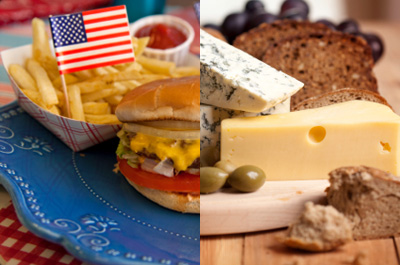
Europeans eat more varied and balanced meals (especially in southern cultures) and less fast food than Americans (except maybe the Brits). Europeans eat more cheese (not just the French !), more yoghurts, and on average drink more wine and stronger beers than Americans.
Americans consume sweeter food and much more soft drinks than Europeans. US alcohol laws are much tougher than anywhere in Europe (see

Sports
It is interesting how the popularity of sports can be so different between Europe and North America. The most popular sports in ALL Europe is football (soccer), probably followed by tennis, cycling, and Formula 1 (as well as other motor races). In the US, soccer and F1 are far away in the popularity ranking. It is baseball, basketball, ice hockey and American football that attract the crowds and make money. And as much as European sports lack popularity in the US, the reverse is true (except for basketball).

Advertising
Advertising practices vary greatly between Europe and North America (especially the USA). While it is common to see people wearing inflatable costumes to promote products on American streets, it is very rare or never observed in most European countries. Likewise, Americans like to place giant billboards along highways/mottorways, this practice is absent (usually illegal because too distracting) in most of Europe, where the only signs are public awareness campaigns for safer driving.

Street names
Street naming practices vary between countries and cities. But one of them, attributing numbers (e.g. 5th Avenue or 16th Street) instead of names, is typically North American. This practice is almost unheard of in Europe, where streets either have a name or, in rare cases for isolated country roads, nothing. All roads outside cities are obviously part of a numbering scheme both in Europe and North America, but those come on top of the names. For example, the A40 between London and Oxford is known as Oxford Road in the Greater London, and London Road beyond that. It is common in most European countries to name roads connecting cities after the city to which they lead. This custom is occasionally found in the USA, notably in New England, but never as systematic as in Europe. The only exception in Europe are motorways (AmE: highways), which are not named anywhere, although they generally have two numbers: a national one (e.g. A1 or M25) and a European one complying with the United Nations's International E-road network (e.g. E15 or E60).

Naming practices
Americans are possibly the only people in the world who have taken the habit to use surnames as given names, and this trend is getting increasingly popular. These are names like Jackson, Cooper, Harrison, Mason, Jenson, Austin, Sheldon, Tyler, Riley, Dylan, Bradley, Roy... They are mostly boy names, but girls aren't immune either. Taylor, Cameron, Mckenzie, Addison and Maddison are just a few examples. This practice was originally used mostly for middle names (as in John Fitzgerald Kennedy, or William Jefferson Clinton), but has become widely used for first names since the second half of the 20th century.

Dating & Marriage
While marriage is increasingly seen as a completely optional "folkloric tradition" in Europe, it is still quite important in the USA (probably because religion is also more important there). Statistically Americans marry much more than Europeans, but also divorce more. Gay marriage, now legal in several EU countries and hardly an issue for debate in Europe (because of the little importance of marriage in Europe nowadays), is still vehemently opposed by a big part of the US population.
Wedding ceremonies are also much more important and formal in the USA. In most of Europe it is limited to an informal family gathering (usually at the bride or groom's parental home). Marriage traditions do vary considerably between European countries, and even more between families. But in average it is certainly less important than in the States (or in Asian countries for that matter).
Furthermore, there are some strong nationwide American traditions regarding wedding ceremonies, like bringing "something old, something new, something borrowed, and something blue". There is obviously no equivalent thing at a European level, and most often not even at a national or regional level.
In fact, even the way of dating tends to follow so well-defined rules in the USA. For instance, there are widely followed conventions about sleeping on the 3rd date. Men know they shouldn't expect to see a woman again if she insists to split the bill ("check" in AmE) at the end of their first date. The way of proposing, or buying an expensive ring are more important for Americans too. In Europe, the way of doing things is more informal and spontaneous, and can varies a lot from one region to another, and even on a person to person basis. Sometimes, that makes Europeans envious of how easy and clear things look in the USA in comparison. The drawback is that it seems too stereotypical, especially if you don't like the conventions.

Nobility
Europe still has a class of noble people (restored in Eastern Europe after the fall of communism), and many countries will mention the title (e.g. Baron) in official documents. About 1% of family names still have a "noble particle" (uncapitalised "de", "di", "von", "van", etc.) and it does have a meaning for some people. Europe also has hundreds of thousands of castles reminding people on a nearly daily basis of the time where nobility once ruled over everything.

Military politics
It is prohibited in most of Europe for the military people, or anyone with a professional military history to become a politician. This means that they become politically ineligible. In the USA, the reverse is almost true. It is almost required to have a military history to become president, and quite a few Congress people have also served in the army. Maybe this is because the president's image is still strongly associated with that of the "commander in chief", and because defence (or offence) is so important in US politics.


Written by Maciamo